A new report from the European Union Agency for Fundamental Rights (FRA) confirms what many in the civil society sector already feel in their daily work: the space to operate freely, safely, and sustainably is shrinking. The Civic Space Update: Enabling Civil Society to Uphold EU Values and Strengthen Democracy, published in March 2026, offers the most comprehensive EU-wide picture to date of the challenges facing civil society organisations – and it makes for sobering reading.
The scale of the problem
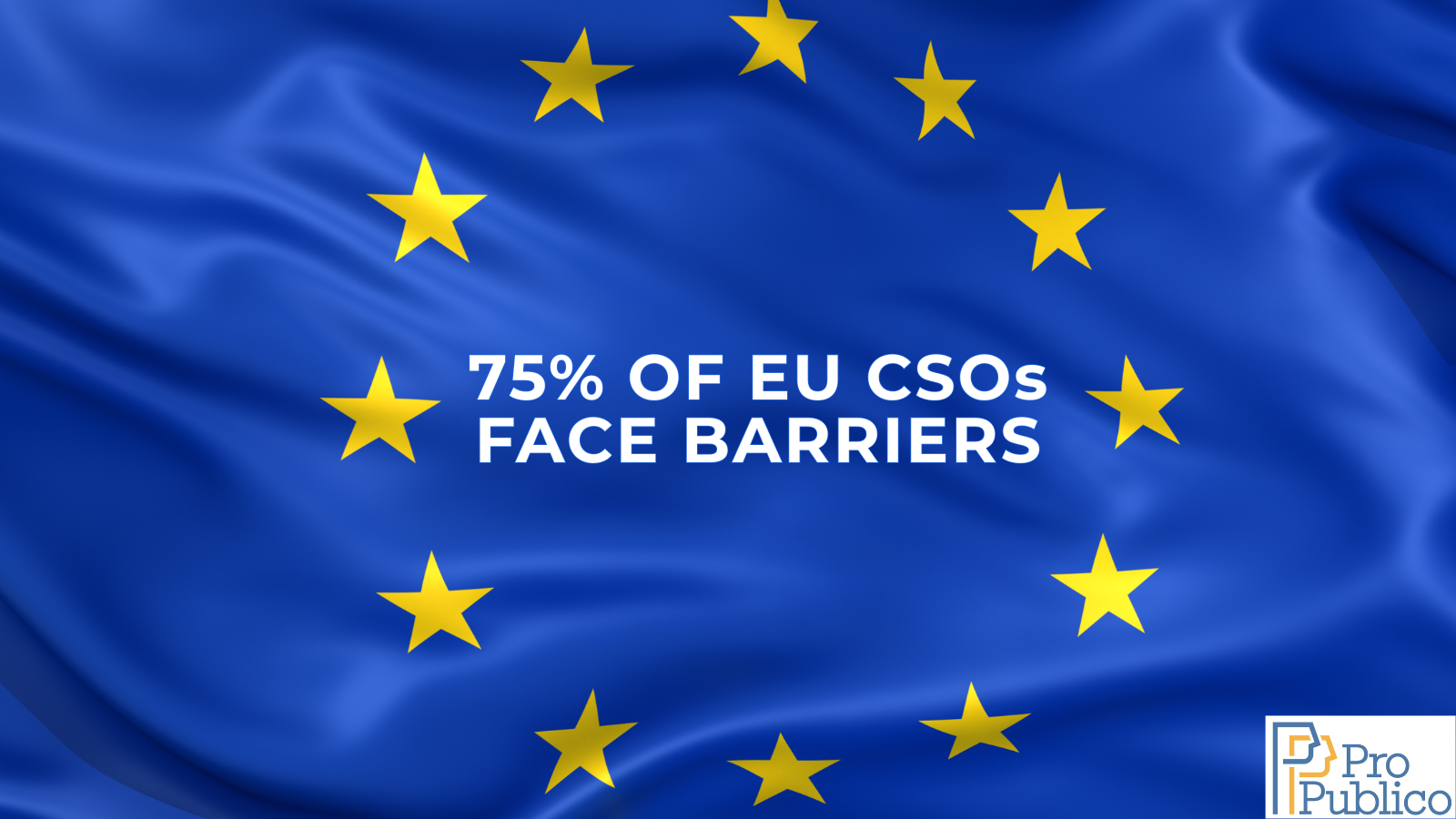
The headline figure is striking: 75% of civil society organisations (CSOs) active in the field of fundamental rights reported barriers to conducting human rights activities in 2024. More tellingly, 70% of respondents said that conditions at the EU level had deteriorated over the past year – with 22% describing the deterioration as significant.
The range of pressures is broad. Online verbal attacks and threats were the most commonly reported incident (67% of respondents). Negative media campaigns, politically motivated funding cuts, excessive administrative controls, and in-person threats followed. One in ten organisations reported that a staff member or volunteer had been physically attacked in 2024. And yet, 61% of those who experienced incidents did not report them – most citing the belief that nothing would change.
The toll on people is real. Four out of five organisations reported that their staff or volunteers had experienced psychological effects including burnout, depression, and anxiety as a result of external pressures.
Funding: a deepening crisis
The funding picture is equally concerning. Nearly half of responding organisations (44%) reported an unexpected reduction, cut, or freeze in funding in the preceding 12 months. Short funding cycles create administrative burdens and force CSOs into short-term project logic, undermining long-term impact. Meanwhile, foreign funding laws – in some EU Member States – are being used to stigmatise organisations as “foreign agents,” with disproportionate fines and even dissolution as possible consequences.
The report is clear that this is not just a matter of resource scarcity. In some cases, rules ostensibly designed for transparency or counter-terrorism financing are having a chilling effect on advocacy and watchdog activity – including self-censorship among organisations fearful of losing charitable status or public funding eligibility.
Where legal support fits in
The report touches on SLAPPs as one of the documented pressures on civic space actors – with 10% of responding organisations reporting experience of strategic litigation in 2024. But the legal dimension runs deeper than SLAPPs alone. CSOs operating in restrictive environments, facing administrative harassment, or navigating complex funding regulations increasingly need legal guidance simply to continue their core work. Access to justice – in its broadest sense – is a civic space issue.
This is where pro bono legal support has a concrete and practical role to play. Organisations that cannot afford specialist legal advice on regulatory compliance, funding restrictions, or their rights in the face of administrative interference are at a structural disadvantage. Connecting them with law firms willing to provide that support is not a peripheral activity – it is part of the infrastructure that keeps civil society functioning.
“What the FRA report captures is the cumulative weight of these pressures. No single obstacle is necessarily fatal, but funding insecurity, legal harassment, online attacks, and administrative burdens combine to erode organisations’ capacity over time. At Pro Publico, we see the legal dimension of this picture acutely: it reinforces why accessible, high-quality pro bono support for civil society is not a nice-to-have; it is part of what a functioning civic space requires.” – Francesco Zatelli, Managing Director of Pro Publico
What the FRA recommends – and what needs to happen
The report’s recommendations span four areas: better monitoring of civic space developments using consistent indicators; national strategies to protect and empower civil society; improved access to diverse and sustainable funding; and meaningful participation frameworks for CSOs in policymaking.
On monitoring, the FRA will cooperate with the European Commission to establish an online information hub – a one-stop shop for civic space data and protection resources. On participation, the report calls for binding consultation rules, adequate timelines, and genuine feedback mechanisms. These are sensible proposals. The question is whether Member States will act on them.
The EU Civil Society Strategy, adopted in 2025, provides a policy framework with real potential – including an explicit commitment to legal pro bono in Article 4.1 that Pro Publico has been actively working to build on. The FRA report reinforces the urgency of implementation.
Civil society is not a policy constituency to be managed. It is the connective tissue of democratic life. Protecting it – through law, through funding, and through access to legal support – is a democratic imperative.
📖 Read the full FRA Civic Space Update: https://fra.europa.eu/en/publication/2026/civic-space-update