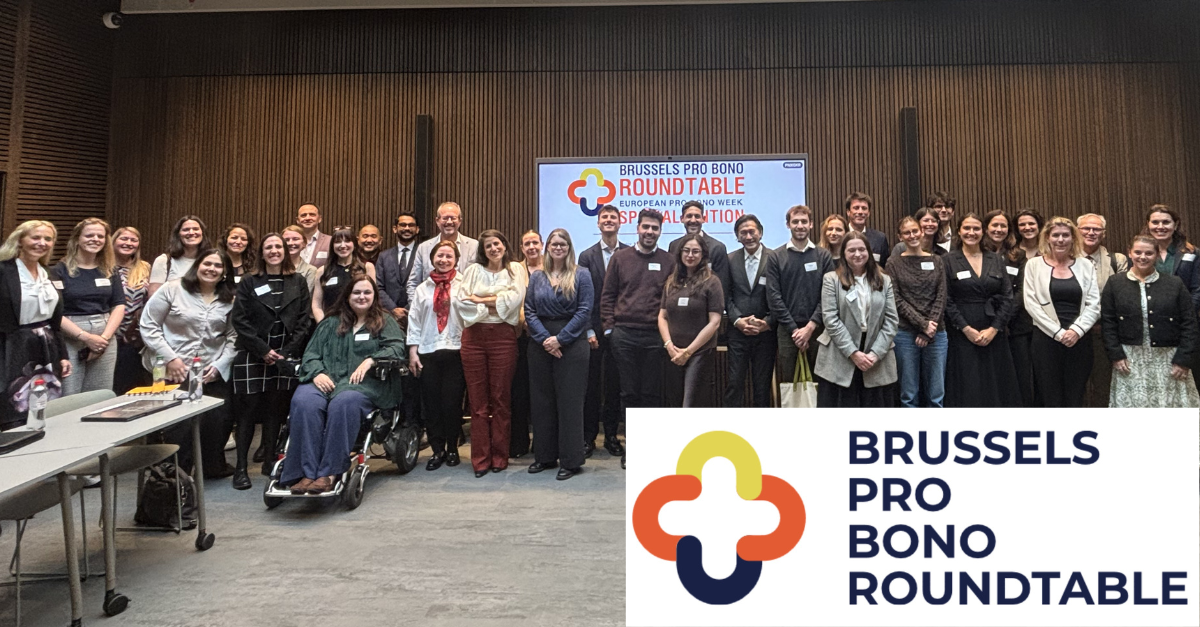
On 11 June 2026, the Brussels Pro Bono community gathered at Mayer Brown‘s offices for a Special Edition of the Brussels Pro Bono Roundtable – timed to coincide with European Pro Bono Week and its theme “Reinforcing pro bono ecosystems: Building partnerships that last”.
The evening brought together lawyers from some of Brussels’ leading international firms, civil society organisations, EU institutions, and the broader pro bono community for what proved to be one of the most substantive roundtables to date. Here are the key takeaways.
A Helpdesk That Turned a Crisis Into a System
The evening opened with a presentation by Helene Asselman and Claire Devillez on the Legal Helpdesk, a Brussels-based initiative jointly run by Vluchtelingenwerk Vlaanderen and the Barreau de Bruxelles. Launched in 2022 in direct response to Belgium’s ongoing reception crisis, the help desk has since assisted over 12.000 asylum seekers who were left without shelter or institutional support despite repeated convictions of the Belgian state. Through partnerships with grassroots associations, volunteer translators, and pro bono lawyers, the help desk has contributed to over 11.000 convictions by Belgian Labour Courts, 2.286 interim measures, and two convictions by the European Court of Human Rights. For the pro bono community, it stands as one of the clearest examples of what structured, sustained collaboration can achieve.
The Data Behind the Rule of Law – and What Pro Bono Can Do About It
Srirak Plipat, Senior Director at the World Justice Project, presented sobering findings from the WJP Rule of Law Index 2025: 68% of countries experienced a decline in the rule of law over the past year, with erosion visible in accountability, fundamental rights, and civic space. Even in Europe – a relative stronghold – the trends are concerning: regulatory pressure on civil society, restrictions on public participation, and a shrinking space for independent media. The WJP’s EUROVOICES study, drawing on over 8,000 expert assessments across 110 regions in all 27 EU Member States, offers granular data to help policymakers and advocates identify where to act. The message was clear: data and pro bono work are natural allies in the fight for the rule of law.
A Historic Recognition from the EU Commission
Perhaps the most significant moment of the evening came from Estelle Massé, Policy Officer of the Fundamental Rights Policy Unit at DG Justice, who presented the EU Commission’s new Civil Society Strategy. For the first time, the Commission has explicitly recognised legal pro bono as a tool for protecting civic space – a landmark acknowledgment for a community that has long operated without formal institutional backing. With CSO funding drying up and civil society organisations facing mounting legal pressure, the Strategy and the future Civil Society Platform open a new chapter for structured pro bono engagement at the European level.
A New Recognition List for Belgian Pro Bono Lawyers
On behalf of the BPBR Organizing Committee, Pro Bono Counsel Mehreen Malik closed the formal programme with a proposal that generated considerable discussion: a Pro Bono Recognition List for Belgium. The idea is straightforward – an annually published, publicly available list of lawyers practising in Belgium who have dedicated a minimum number of hours to pro bono work in the preceding year, each receiving a personal acknowledgement and a digital badge for professional use. Belgium already has the quarterly Roundtables, European Pro Bono Week, and the Pro Publico Awards. This would complete the picture by putting individual lawyers in the spotlight.
“What makes these evenings special is the diversity in the room -CSOs, researchers, policymakers, lawyers, all pulling in the same direction. I’m deeply grateful to our speakers and to everyone who showed up. We are this community.” – Francesco Zatelli, director of Pro Publico
What Attendees Said
The feedback from the evening reflected the energy in the room. Attendees praised the “fantastic variety of speakers and topics” and the rare quality of an event where, as one participant put it, “every section of the roundtable had a powerful message and a very clear call to action.”
Several first-time attendees highlighted the Legal Helpdesk as an immediate and tangible opportunity for their Brussels offices to get involved. The diversity of the room itself – bringing together local practitioners, EU-level actors, and international firm lawyers – was consistently singled out as the evening’s greatest strength. More than one attendee noted the discussion ended too soon, with calls for longer Q&A sessions and structured peer-to-peer exchanges between attendees in future editions.
We hear you – and we’re already planning the next one.
The evening closed with a networking reception that lived up to its purpose – new connections made, existing partnerships deepened, and a shared sense that the Brussels pro bono ecosystem is not just surviving, but growing.
What comes next
The calls for conversations that sit with challenges (not just opportunities) have been heard. Brussels has a particular landscape for civil society, one that is rarely straightforward, and future editions will aim to reflect that more fully.
The conversation does not stop here. The Brussels pro bono community is growing, and roundtables like this one are proof that the appetite for meaningful collaboration is very much alive.
Special thanks to Mayor Brown for hosting and to the Organising Committee for bringing this edition to life :
Marcia Maack, Mehreen Malik, Jean-Philippe Montfort, Camille Worms, Javier Saladich – Mayer Brown
Byron Spring – Cleary, Gottlieb Steen & Hamilton
Francesco Zatelli – Pro Publico
Michalis Papachristodoulou – Reed Smith
Sophie Brambley – Linklaters
Staś Kuźmierkiewicz – Covington & Burling
Interested in getting involved with Pro Publico? Reach out, follow our updates, or join our next event.